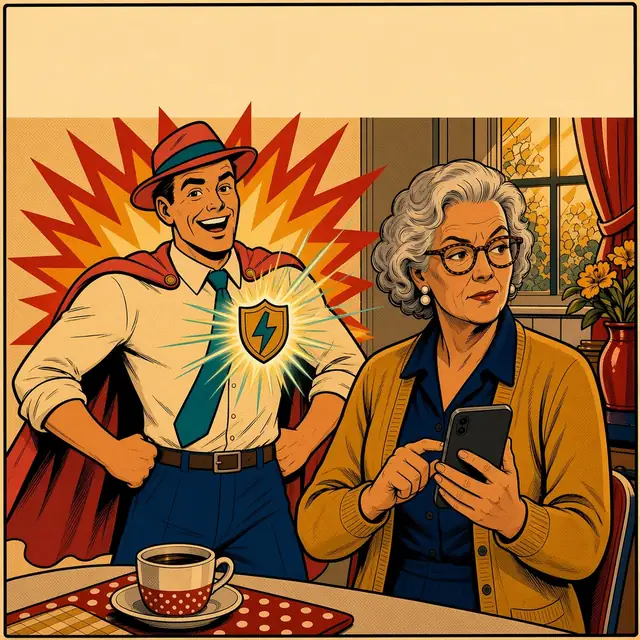
KA-POW! Is the "your account is locked" text a scam?
Treat it as one until you've checked. A surprise text or call saying your bank account is locked, or asking you to reply YES/NO about a charge and then "verify," is one of the most common setups, and no real bank will ever ask you to move your money to keep it safe (FTC, 2025). Don't reply or tap. Call the number on the back of your card.
FIRST HOMETOWN BANK ALERT: Did you attempt a purchase of $1,248.00 at ELECTRO-MART? Reply YES or NO. (You reply NO. Your phone rings a minute later.) "This is the fraud department. To secure your funds we'll need to move them to a protected account."
Your account has been temporarily LOCKED due to unusual sign-in activity. Restore access: secure-bank-verify.example
We sent you a code to confirm your identity. Please read it back to the agent so we can stop the fraudulent transfer.
Red flags
"Move your money to a safe account." That's always a scam (FTC, 2025).
"Read me the code we just texted you." That code is the key to your account.
A call right after you reply to a text alert.
A link to "restore access."
Bitcoin ATMs, gold, or cash handed to a courier to "protect" anything (FTC, 2025).
"Don't tell the teller why you're withdrawing."
What to tell your parent
This scam borrows the voice of being careful. It works because your parent takes their accounts seriously.
"If the bank ever texts or calls about a problem, hang up and call the number on the back of your card. That's the real bank. Nobody legit will ask you to move money to 'protect it,' or to read them a code. If they do, that's how you know."
Moral of the story: your bank never asks you to move money to keep it safe.
Checklist: do this now
Don't reply YES/NO or tap the link.
Call the number on the back of your card.
Never move money to "protect it."
Never read a texted code to anyone.
If you don't know, now you KNOW... ⭐🌈
If they already clicked, shared, or paid
Call the bank now on the number on the card or a statement. Tell them what happened, ask them to reverse any transfers, and lock the account (FTC, 2026).
Shared a password or code? Change the password, and anywhere it's reused, and turn on two-factor authentication (FTC, 2026).
Shared a Social Security number? Go to IdentityTheft.gov (FTC, 2026).
Sent crypto? Contact the crypto ATM operator or exchange right away (FTC, 2026). Mailed cash? Call the U.S. Postal Inspection Service at 1-877-876-2455 (FTC, 2026).
In 2025, the biggest share (31%) of older adults' text-scam loss reports involved texts impersonating well-known businesses, particularly Amazon, Apple and banks. These often look like account security alerts. Older adults' reported text-scam losses were up 61% from 2024 (FTC, Protecting Older Consumers, 2026: https://www.ftc.gov/system/files/ftc_gov/pdf/2026-older-adults-report-10192026.pdf).
Fake fraud alerts were one of the top five text scams reported in 2024 (FTC Data Spotlight, 2025).
FAQ
My bank does send fraud alerts. How do I tell? You don't have to tell. Whatever the text says, call the number on the back of your card or open the bank's own app. A real alert will be waiting there.
The caller knew my name and last four digits. That doesn't make them real. Scammers often already have bits of your info. Hang up and call your bank yourself.
They said a government agency is involved now. Scammers often add a fake "government" step after a fake bank step (FBI IC3, 2023). The FTC "will never … say you must transfer your money to 'protect it'" (FTC, 2026).
I replied "NO." Is that bad? It tells them the number is live, but no money has moved. Don't answer follow-up calls from that number. Call your bank yourself.
Felt a Twinge? Text before you tap.
Twinge is a scam second opinion we're building. You forward the alert and get a plain-English read on what it looks like and what to do next. Twinge will never ask for passwords, codes or money. It's in a small free pilot, and the forwarding number isn't live yet. Join the waitlist at asktwinge.com.
Felt a Twinge? Text before you tap. Twinge is in a small free pilot: you forward the text, our engine checks it, and a real person sends you a plain answer.
 twinge